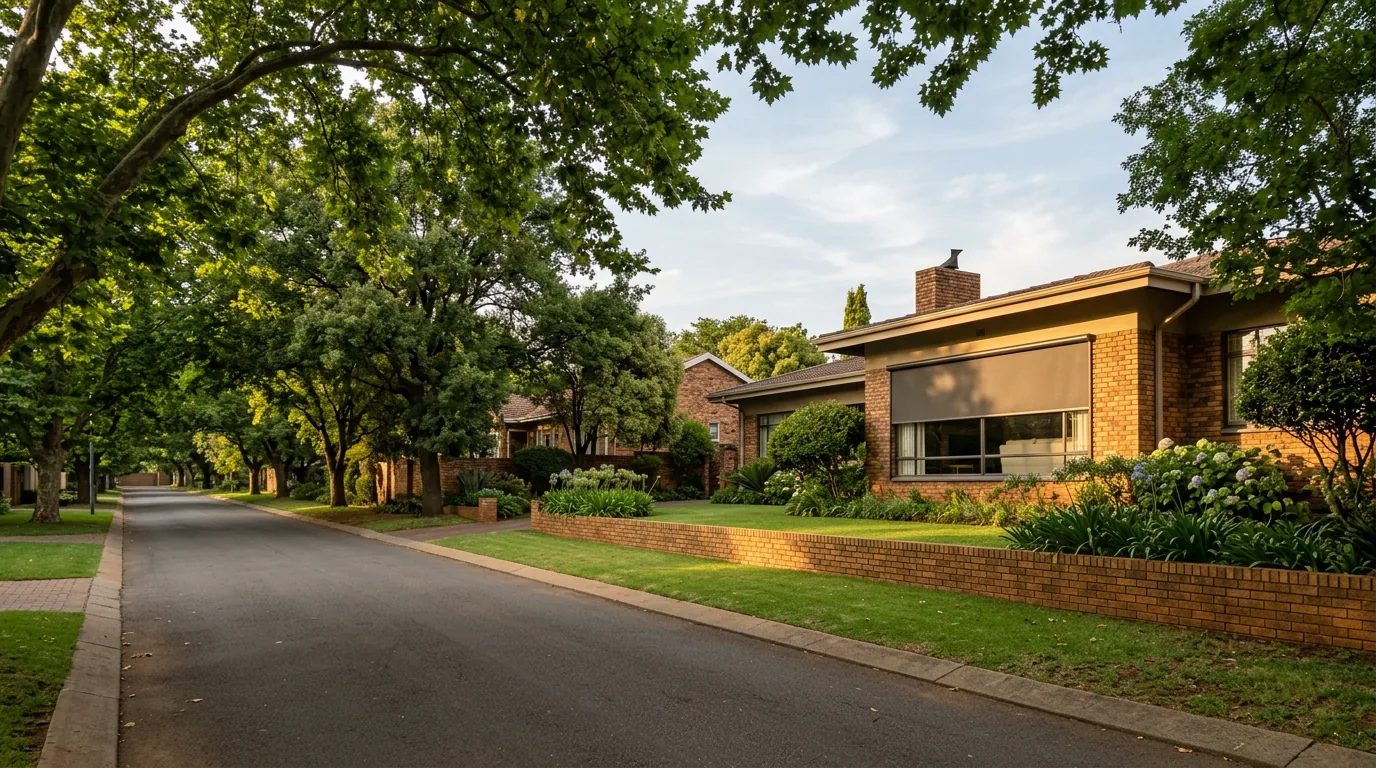
A wide, tree-lined Senderwood street in late afternoon, with a brick family home on a generous stand and a flat sunscreen roller blind half-lowered over its west-facing lounge window
Free area guide · Senderwood

The Long AfternoonThe Senderwood window field guide

What the highveld sun does to a house on a big, tree-shaded Senderwood stand — elevation by elevation, with the trade-offs written down instead of glossed over.

About 8 minutes to read Written August 2026 Free, and nothing is gated Sources at the foot
In this guide Why here is different What the light does Elevation by elevation What we'd fit, and the catch Clusters & complexes What we'd check on site Your two ways forward Sources
01 — The starting point

Why a suburb of big stands needs its own shading brief

Senderwood is an extension of Bedfordview on the Gauteng East Rand, inside the City of Ekurhuleni.[1] It is known for established homes, tree-lined streets and mature gardens on generous stands — with secure clusters, townhouses and newer developments such as The Neighbourhood among them.[2] Saheti School is in the suburb itself, which is much of why families move here.[1][3]

Three things about that mix change how a blind gets specified.

The trees already do half the shading — unevenly, and only for half the year. A deciduous tree over a north window is a free awning in January and gone by July, exactly when you want the sun back.

Most houses carry more than one generation of window. Kitchens get opened up and patios gain stacking doors, leaving original openings on one side and new aluminium glazing on the other — which is why every quote measures each window on its own.

And there are really two Senderwoods. On a freestanding stand the enemy is heat and low glare; in a cluster, where the neighbour's window is close, privacy is the brief.

02 — The light here

What the sun actually does over Senderwood

Bedfordview — the coordinates Senderwood shares — sits at 26°10′46″S, 28°08′10″E, 1,639 m above sea level.[4] The clearest published South African sun-path work, calculated for Pretoria fifty kilometres north, puts the sun 87.7° above the horizon at noon on 21 December and only 40.84° on 20 June.[5][6]

That 47-degree swing splits the year. In midsummer the noon sun is nearly overhead, so a north window with a decent eave largely shades itself at midday. In June it sits at about 41° and due north, pushing warmth deep into the room — which, with July lows averaging 9.5 °C, is heat you want.[7]

The problem is the long afternoon. On 21 December the sun sets on a bearing of 243.35° — about 27 degrees south of due west.[5] From about three o'clock it arrives almost horizontally, and no eave blocks a horizontal ray. The study puts it flatly: western afternoons run far hotter than the mornings.[5] On that side of the house, shading has to sit at the glass or outside it — never above it.

Two more facts that change the specification

  • Storms and hail, most summer afternoons. Bedfordview takes about 755 mm of rain a year, roughly 135 mm in December across about fourteen rainy days.[7][8] Hail is more frequent over the Gauteng Highveld than most of the country; storms last about fifteen minutes, with large stones falling at over 160 km/h.[9] Anything folding out over a patio must get itself back in — which makes a wind sensor a specification item, not an upsell.
  • Altitude, and the UV with it. The Highveld sits 1,200–1,800 m up, and cloudless skies plus altitude make for high ambient solar ultraviolet,[10] climbing roughly 10% per 1,000 m.[11] Fabrics on the sunny side age faster here than at the coast — our experience, not something those papers measure, but it is why we pick a west fabric on performance before colour.
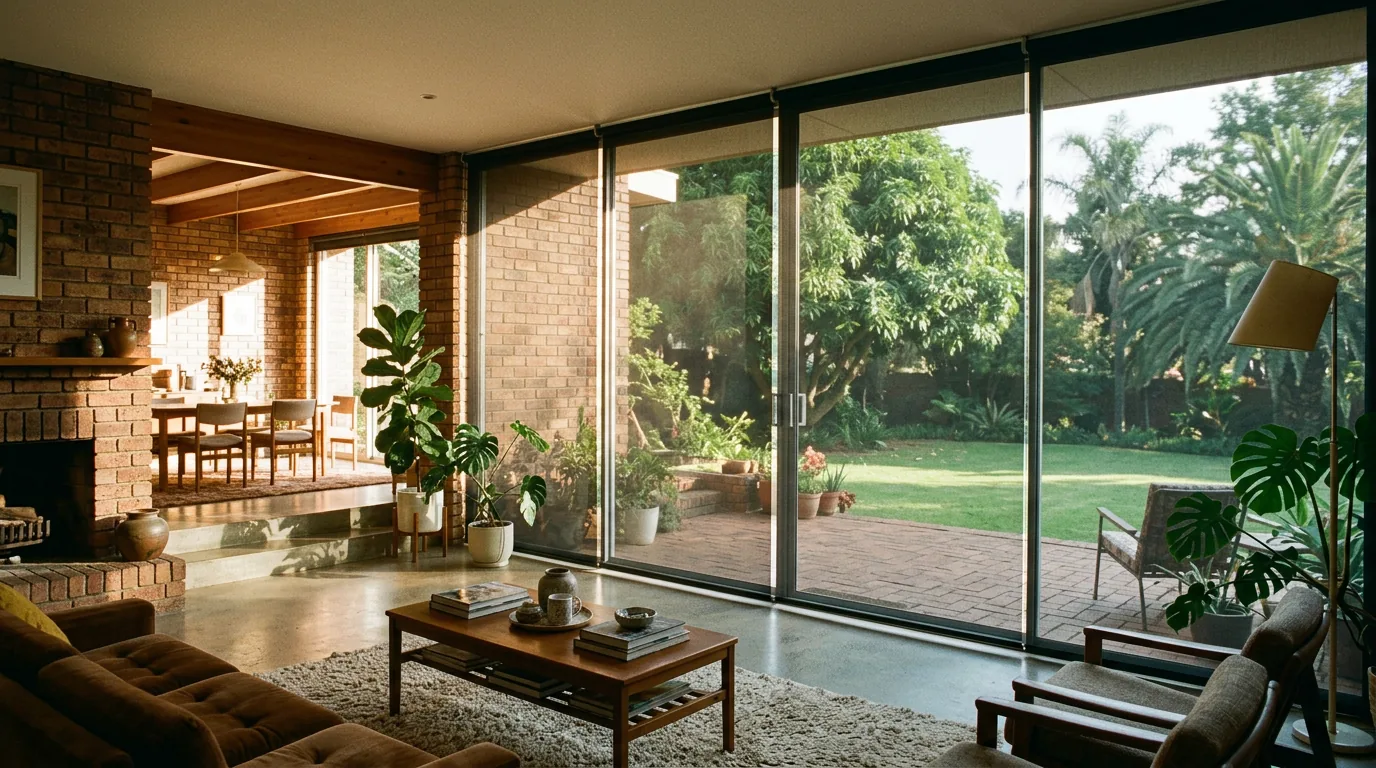
A single flat sheet of open-weave sunscreen roller blind fabric lowered over west-facing sliding doors in an open-plan Senderwood lounge, cutting the low afternoon glare while the garden stays visible through the weave
Four o'clock, west elevation. An open-weave sunscreen holds the glare down without blanking out the garden — the compromise most west-facing rooms here are looking for.
03 — Room by room

Elevation by elevation, and which rooms suffer

One house, four problems. Work out which wall a room sits on first.

North — protect in summer, open in winter

North is where the sun lives all winter: high enough in midsummer that an eave does most of the work, then at about 41° and pouring in by June.[5] Rooms here want something you can angle — summer light bounced off the ceiling, opened flat in winter. A blockout roller is a blunt instrument here.

Verdict: adjustable beats absolute.
West — the elevation that costs you the afternoon

Low, near-horizontal sun from about three o'clock, from 27° south of west at midsummer.[5] On a big stand this is usually the lounge and patio doors, because that is where the garden view is. If the room is unbearable at four, the glass itself is heating and radiating inwards — so an interior blind fixes the glare at once and the heat only partly.

Verdict: stop it outside the glass if you can; a proper sunscreen if you can't.
East — glare and sleep, not heat

The same geometry mirrored, into a house that cooled overnight. In a school-run suburb the December sunrise is the real complaint. Kitchens take an hour of hard glare and then it's over — so blockout in the bedrooms, see-through in the kitchen.

Verdict: solve for glare and sleep, not for heat.
South — even light, cold mornings, close neighbours

Almost no direct sun most of the year, so these rooms hold the steadiest light in the house — and are the coldest on a clear winter morning.[7] Shading is rarely the problem; heat loss through older single glazing usually is, which is what a cellular honeycomb blind holding still air against the pane is good at. On a cluster stand, so is a neighbour's window.

Verdict: think warmth and privacy, not sun.
Optional

Want this marked up for your own house?

Tell us which rooms are giving you trouble and we'll send this guide back with your elevations noted against it. It's an email, not a visit — nobody phones you about it.

Your details are used only to send you this guide and, if you ask for it, to arrange your free in-home measure. They are never shared with third parties (POPIA).

04 — The specification

What we'd fit here, and the catch with each

Each is right somewhere here and wrong somewhere else. Tick anything that sounds like your problem — it carries into the form below.

Sunscreen roller blinds

West lounge · patio doors

One flat sheet of open-weave fabric on a tube — no folds, no pleats. It knocks the low afternoon glare down and takes out a useful share of the solar gain while leaving the garden visible.

The trade-off

It reverses after dark: the weave that let you see out lets people see in. On a small stand, pair it with a blockout on the same window.
Roller shutters (shading)

The hardest west glass

Rigid aluminium slats rolling down from a headbox on the outside of the building, in slim side guides. On a punishing west elevation we'd specify these over an interior blockout roller, and the reason is physics rather than preference: stopping the sun before it reaches the pane keeps a room cooler than absorbing it inside, where the glass warms and radiates all evening.

These are shading shutters, not security-rated shutters — a different product, available on request.

The trade-off

The most visible change to the outside of the house, and the headbox has to live somewhere: a design decision, not a measurement. They also sit outdoors in a hail belt.[9]

Blockout roller blinds

Bedrooms · east

The same flat sheet, in a fabric that stops light rather than filtering it. Against a December sunrise on an east bedroom window it is the most effective thing there is.

The trade-off

Binary: down is dark, up is everything — the wrong tool for a north living room. And without side channels, light finds the edges of the reveal.

Timber venetian blinds

North living · studies · original reveals

Where light changes character through the day — dappled under a big tree at nine, hard by two — the useful control is angle, not coverage. Timber slats throw summer sun onto the ceiling and open flat in June.

The trade-off

Heavier and dearer than aluminium, and a wide opening splits across two headrails. Near steam we'd swap to an aluminium slat: timber and moisture age badly together.

Day & night blinds

Clusters · townhouses · street-facing

Sheer and solid bands sliding past each other on one roller, so you hold privacy from a neighbour a few metres away and still keep usable daylight — often the honest answer in a cluster.

The trade-off

More mechanism than a plain roller, so more to go wrong, and it never goes fully blockout. Not for a bedroom you want dark.

Folding-arm awnings

The braai patio

Where the garden is the extra room — which on a Senderwood stand it usually is — an awning over the paving often buys more comfort than anything you could do to a window, and folds away so the winter sun still reaches the house.

The trade-off

Wind ratings are a real limit, not a suggestion, in a storm-and-hail belt.[8][9] Over a braai we'd specify a motor with a wind sensor so it retracts before the storm.

Also on the list below: aluminium venetians where timber would not last, cellular blinds for cold south rooms, vertical and panel blinds for openings too wide for one roller, plus concealed, skylight and shaped blinds, motorisation, curtain tracks and repairs.

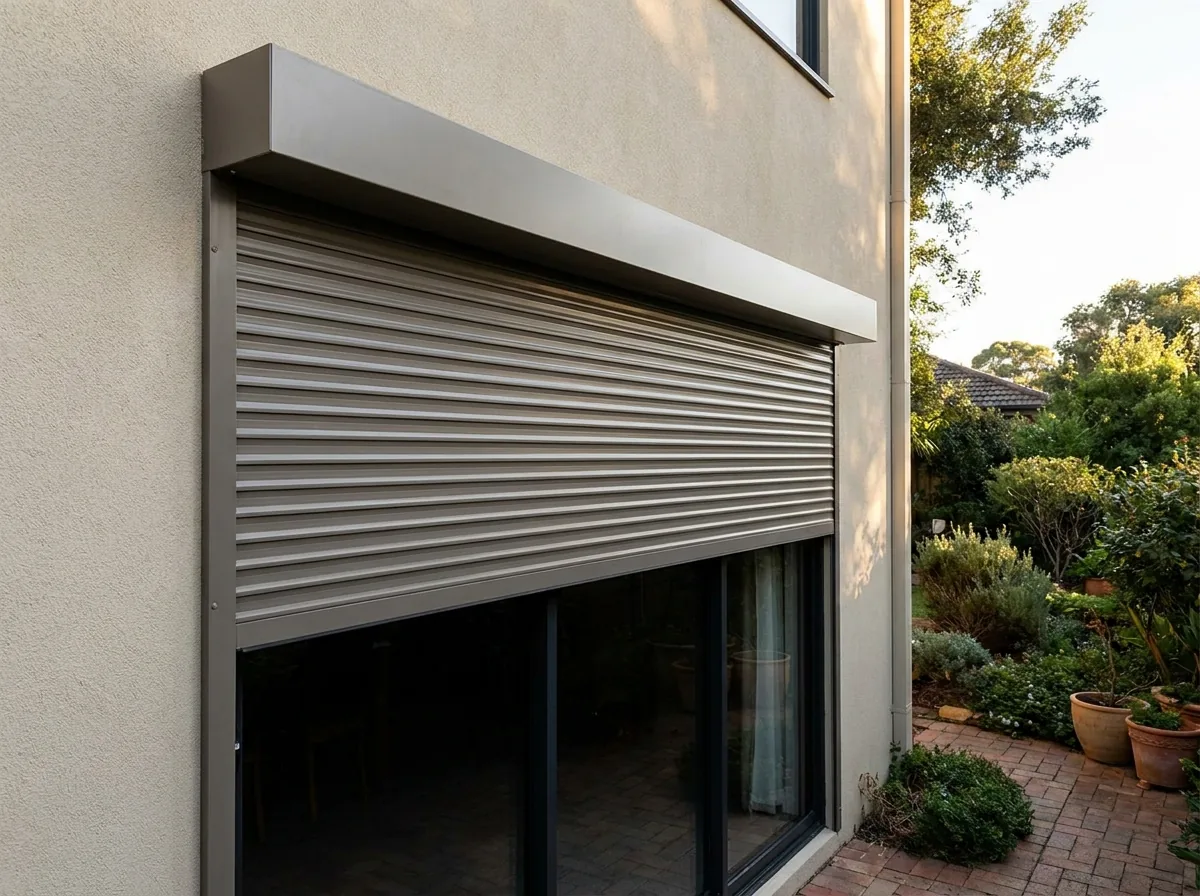
An external aluminium roller shutter part-lowered on the outside of a west-facing sliding door, its rigid horizontal slats running down from a headbox in slim vertical side guides
Stopped outside the glass. A roller shutter shades the pane before the sun reaches it — the difference between a room that stays cool and one that radiates heat back all evening.
05 — The local constraint

Clusters, complexes, and the outside of the building

A good share of Senderwood is now secure clusters, townhouses and newer developments,[2] which changes one thing: anything mounted on the outside of the building is generally not only your decision. Bodies corporate and HOAs normally have a say over a unit's external appearance — an awning, a roller shutter, its side guides. Every scheme writes its own rules and we haven't seen yours, but on the measure we'll say plainly which recommendations touch the outside.

  • Interior blinds in an existing opening change nothing anyone else can see — almost never a scheme's business.
  • Exterior products — awnings, roller shutters, external channels — change the elevation. On a freestanding stand that's your call alone; inside a complex, ask first.

And if you're mid-renovation: SANS 10400-XA:2021 (Edition 2) requires a fenestration calculation once glazing exceeds 20% of floor area — it was 15% before — and no longer distinguishes the solar-heat-gain requirements of west, north or east glass.[12] We fit blinds, not compliance, so ask your architect early how your shading is counted.

06 — The honest limit of a guide

What we'd still need to check on site

Everything above is what we know about Senderwood. What no guide knows is your house — and these four decide the specification.

Reveal depth, whether it's square, and what the wall is made of

Depth decides whether a blind fits inside the opening at all, and whether a headbox has anywhere to go. Older openings are rarely square — ten or twelve millimetres top to bottom is normal. And a steel casement, an aluminium slider and a new extension's stud wall all take fixings differently.

Which way it really faces — and what's growing outside

Twenty degrees changes the answer between west and south-west, so we take a compass reading at the window. Then we look out of it: the tree doing half your shading differs window to window, and half of it drops in winter.

Where the power is, and who uses the room

For anything motorised the constraint is the route from a power point to the head of the window — a walk-around with a torch, not a guess. And a cot near a corded window changes the recommendation on the spot.

Wind exposure and fixing height on the patio

Awnings live or die on this. A sheltered courtyard and an exposed western corner want different products and sensors, and fixing height above the door governs how far one can project.

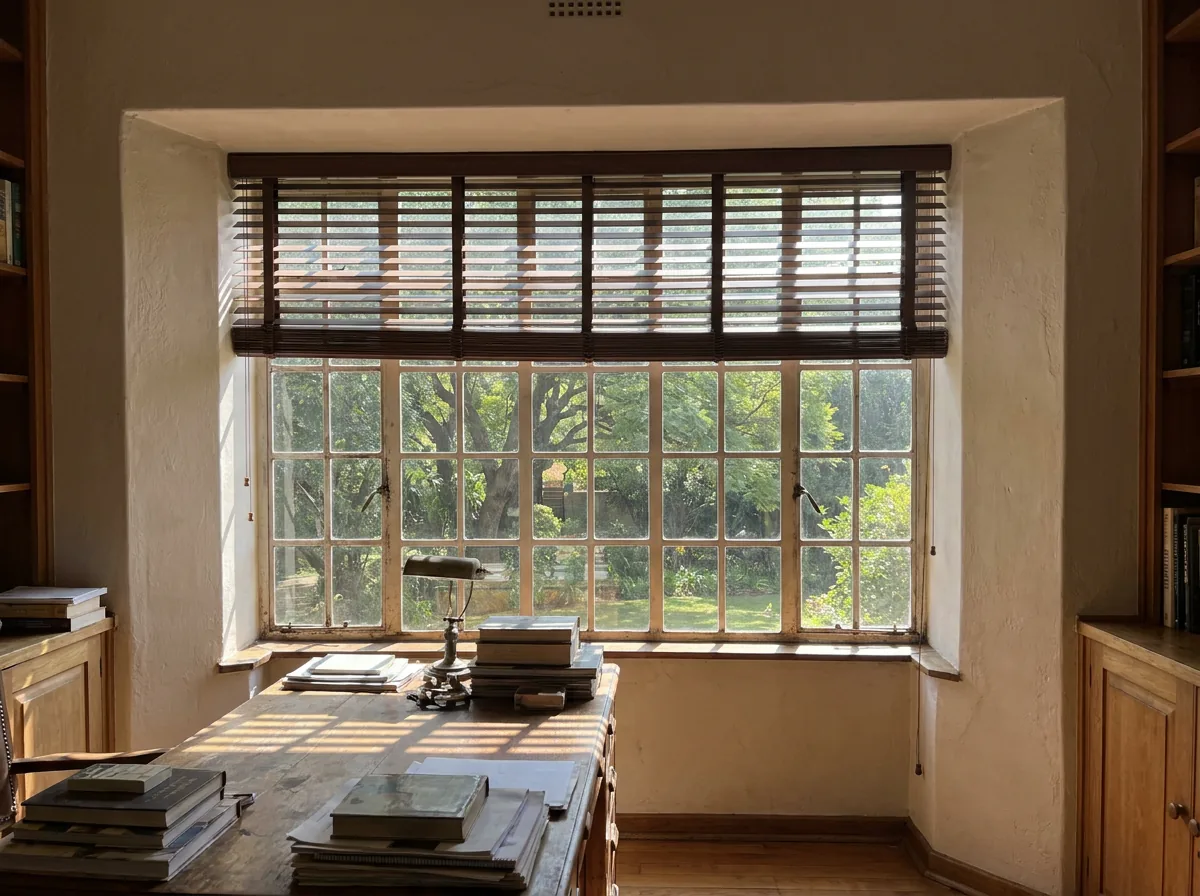
A timber venetian blind fitted inside the deep reveal of an original steel-framed casement window in a Senderwood study, its flat wooden slats tilted half open to throw bands of light across a desk
Inside the reveal. On an original steel casement, the blind has to work with the opening it's given — which is a measurement, not a guess from a photograph.
07 — Two ways forward

Book the free expert measure

A consultant comes to your home with samples, measures every window, and leaves you a written quote per window. It costs nothing and commits you to nothing. Prefer a rough number first? The ballpark list under the form does that.

Free in-home measure and a written quote per window
No call centre — a real consultant comes out
Nothing is made until you've approved the quote
Still deciding? Say so, and we'll leave you be

Our consultant does five to six measures a week across this area, so book ahead if you need a particular day.

Anything you ticked while reading is already in the form.

What are you interested in? (tick any)
Want a ballpark figure first? Open this — about two minutes.

Senderwood Blinds — window list

Walk the house, fill this in by hand, then type it into the form on senderwoodblinds.co.za when you get back. Measure the width first, then the drop, in millimetres.

Pop in rough sizes and we'll send a budget range by the next working day. Not sure how to measure? Leave it blank — our consultant measures for free and you'll get exact per-window pricing either way. This is entirely optional and nothing here is binding.

Room Width (mm) Drop (mm) Inside or outside the reveal Product Remove

Nothing on the list yet — and it stays entirely optional.

Anything you enter here travels with your enquiry as plain text. No uploads, no third-party services, nothing stored anywhere else. If photographs would help, a consultant will simply ask for them in the reply.

Your details are used only to arrange your free in-home measure and consultation call-back, and are never shared with third parties. If you tell us you're still researching, we won't phone you (POPIA).

Neither, for now

Just take the guide, marked up

Not ready for a visit or a number? Tell us which rooms are the problem and we'll email this guide back with your own elevations noted against it.

Used only to send you the guide. Never shared with third parties (POPIA).

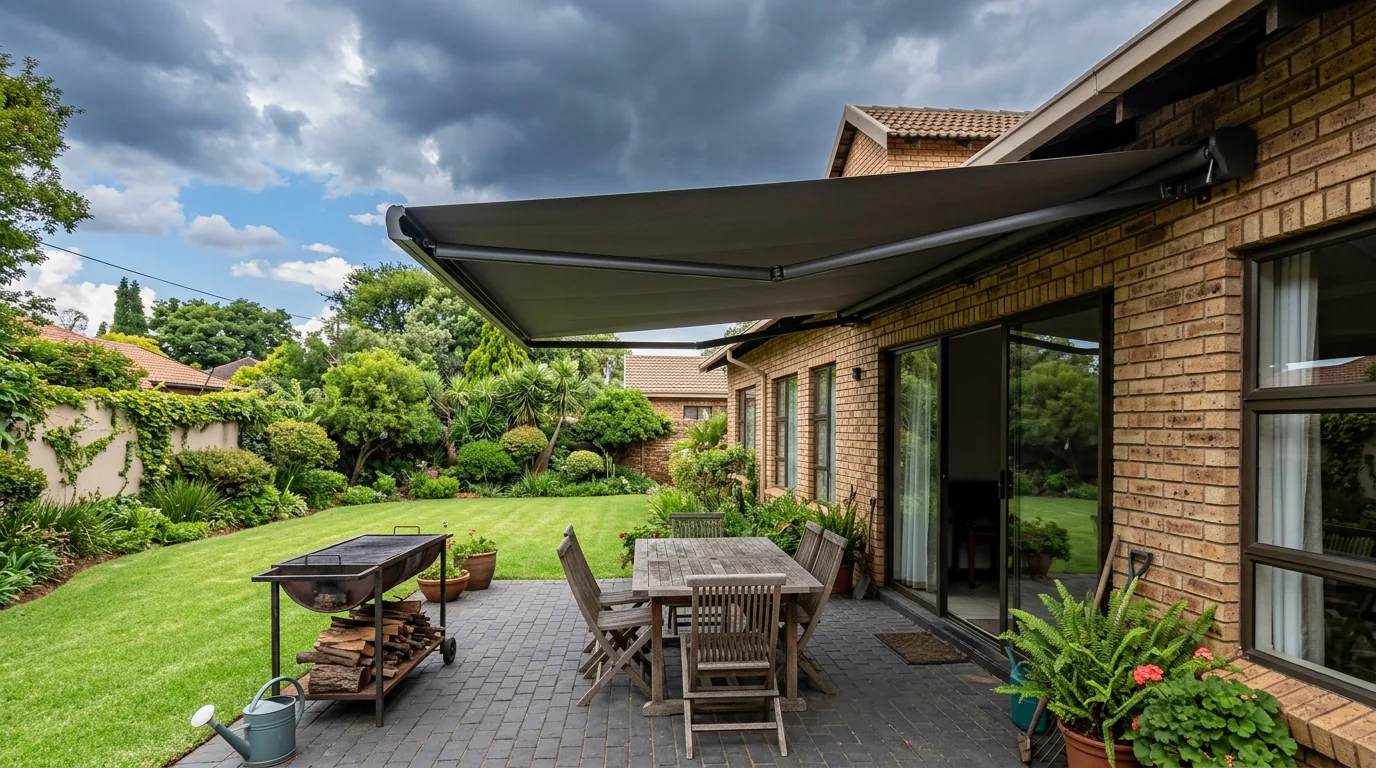
A folding-arm awning extended over a paved braai patio behind a Senderwood home, its flat fabric canopy on articulated arms, with a highveld thunderstorm building in the sky behind the garden
The patio question. Projection, fixing height and wind exposure get decided standing on the paving — and on the highveld the storm is part of the specification.
Working out

Sources

Every climate, geography, suburb and regulation claim above traces back to one of these. Where we've reasoned from trade experience instead of citing something, we've said so in the text.

  1. Senderwood area profile — an extension of Bedfordview on the Gauteng East Rand within the City of Ekurhuleni, close to the R21/R24 interchange and the N3, roughly 10 km from OR Tambo, and near Saheti, St Benedict's College and Reddam House Bedfordview. chaseveritt.co.za — Senderwood
  2. Senderwood area profile — "established homes, tree-lined streets"; a mix of "larger family homes, secure clusters, modern townhouses and newer luxury developments"; "established stands with mature gardens"; and newer developments "such as The Neighbourhood". rrealestate.co.za — Senderwood
  3. Saheti School is situated in Senderwood, Bedfordview, and caters from pre-primary to matric. schoolguide.co.za — Saheti School
  4. Bedfordview — coordinates 26°10′46″S, 28°08′10″E, elevation 1,639 m, part of the City of Ekurhuleni Metropolitan Municipality since 2000. en.wikipedia.org/wiki/Bedfordview
  5. "Sun, shade and natural daylight in South African town planning, with emphasis on Pretoria" — solar noon altitude of 87.7° on 21 December and 40.84° on 20 June, a December sunset azimuth of 243.35°, and the finding that afternoons on a western exposure are far hotter than the mornings. scielo.org.za — S2415-04952018000200005
  6. Independent solar figures calculated for Johannesburg (latitude −26.2°): peak altitude of about 87.2° at the December solstice and about 40.4° at the June solstice. geotimedate.org — Johannesburg sun
  7. Bedfordview area profile — subtropical climate with almost daily rain showers in summer, a rainy season running October to April, January the hottest month and July the coldest with an average low of about 9.5 °C. seeff.com — Bedfordview
  8. Bedfordview rainfall by month — about 755 mm a year, roughly 135 mm in December across about 14 rainy days, and about 3.5 mm in July. weather-and-climate.com — Bedfordview rainfall
  9. Hail in South Africa — hail occurrence is higher on the Highveld areas of Gauteng than in most of the country; hailstorms usually occur in the middle to late afternoon, usually last about 15 minutes, and large hailstones fall at speeds of over 160 km/h. southafrica.co.za — Hail in South Africa
  10. The Highveld sits 1,200–1,800 m above sea level, and its high atmospheric pressure produces cloudless skies which, combined with the altitude, lead to high levels of ambient solar ultraviolet radiation. en.wikipedia.org/wiki/Highveld
  11. Wright et al., "Solar Ultraviolet Radiation, Skin Cancer and Photoprotective Strategies in South Africa", Photochemistry and Photobiology (2023) — ultraviolet intensity rising with altitude, and South Africa's high ambient UV levels. onlinelibrary.wiley.com — php.13676
  12. SANS 10400-XA:2021 (Edition 2) — the fenestration-calculation threshold rising from 15% to 20% of floor area, and the removal of any distinction between the solar-heat-gain requirements of glazing facing west, north or east. roosarchitects.co.za — the revised SANS 10400-XA

Three honest caveats. The solar figures in source 5 are calculated for Pretoria at about 25.7° south; Senderwood sits at roughly 26.2° south, so its own angles differ by well under a degree — we've quoted the published numbers rather than invent our own, and source 6 is there as a cross-check. We could find no published source that pins a building decade to Senderwood's houses, so this guide never claims one. And we have no copy of any particular complex's architectural rules — the section above says only the general and true thing, which is that external work in a scheme normally needs sign-off.

Next step

Now let's look at your actual windows.

A free in-home measure, a written quote per window, and a real conversation about the rooms that are giving you trouble.